Showing posts with label Dim sum. Show all posts

Saturday, December 19, 2009

Dimsum de Chine


Here's my idea of an ideal Sunday in Beijing: Get up early at about 11am. Work off some calories with my 2-kg dumbbells. Pile back the calories with a lovely dim sum lunch. But with my favourite haunt having some kind of extreme makeover for the last few months and will open only in the new year, I have had to search for alternatives.

It has been a disappointing hunt. So disappointing that I shouldn't call it a hunt. I gave up after just one try. It was the darn Westin and despite charging a premium and having Chinese Cirque du Soleil-like acrobats performing in their restaurant, their dim sum sucked. The siew mais were lumpy, the egg tarts were lukewarm and the pork ribs were, gasp, undercooked. Even my grandmother could do better.


As you can see, the restaurant looked lovely. But I was there for the food and I expected better when I was paying more than S$20. That was some months back. I was disheartened. My ideal Sunday routine was in ruins. I could try harder to find another dim sum restaurant or I could sulk. Like any mature adult, I chose to sleep later and skip Sunday lunch altogether.

But fortuitously, on a wild night out to attack a Peking Duck, I realised that the bird restaurant Duck de Chine serves dim sum for lunch too. I did my mental Logic 101. Premise 1 - it was set up by a Hong Konger. Premise 2 - its duck is good shit. So Conclusion - Dim Sum must also be good shit. My university lecturers must be so proud of me.

So last Sunday, I re-embraced an early Sunday morning and popped lovely tiny pieces of exquisite dim sum into the Forbidden Stomach. It was, to be honest, not the best. But it was definitely more than competent. The chye tow kuay did not have Comfort Inn's crispy edges, but it was tender and did not overload the rice flour. I thought the bean sprouts was a nice touch too.


The standard dim sum dishes like siew mai and hakao were not bad either, having thin skins and fairly juice insides. And at Duck de Chine, you can never fault the service. Ever attentive staff, quick to top up my cup of chrysathemum tea. It was reasonably priced too, with quite a few items at half price. Me and my party of five paid about 80 yuan (S$16) each, no complaints. DDC's dim sum may not make the Dim Sum Olympics. But it is certainly good enough for, erm, the Asian Games?

Thursday, June 18, 2009

Five-star dim sum

Ask someone in Singapore for the best dim sum in town and chances are, they will point you to a couple of top-end hotels - Goodwood Park and Shangri-La. Now ask someone in Beijing for the best dim sum in town and they will say "Comfort Inn". What? Comfort what? This is just wrong. Three-star hotels are not supposed to have five-star restaurants.


But such is the peculiarity of the food scene here that you get good stuff in places least expected, especially for those establishments which have been around for a long time. You have yummylicious Hainanese Chicken Rice at Hard Rock Cafe, so I guess top notch dim sum at Comfort Inn should not be that shocking.

Still, I approached Comfort Inn last Sunday with quite a bit of hungry skepticism. Perhaps it was good donkey years ago when Beijing had more carts than cars, when desperate expats gratefully lapped up anything? But is it still "the best", as claimed by some longtime Beijing Singaporeans?

It is. Pure and simple. Victory hands down. Call off the contest. The Golden Tripod Attic is like S-League compared to the Comfort's English Premier League standards. The dim sum at this place is out of this world and into the next.

The hotel's restaurant, which was first set up in Guangdong province, is actually named Kaiyue. But what the heck, let's just call it Comfort Inn. It's easier. And as you can tell from the pics below, the restaurant is really quite comfortable. Lots of private rooms to choose from.


We ordered a bunch of dim sum, which is really the best way to enjoy the Cantonese delight. And every basket or plate that was served met the salivating approval of me and my friends.


Carrot cake, sliced into little and almost symmetrical cubes, crispy edges, tender insides.


Chee cheong fun, cut into short sticks with a skin so thin it was translucent.


Siew mai and har kow, steamed to perfection, juicy and not oily, allowing you to savour the freshness of the shrimps.

Lo mai kai, killer. Absolute killer. It was so good it was unreal. The glutinous rice so soft that the slightest touch with your chopsticks cut apart the rectangular delight. Slices of shiitake mushrooms and pork belly within. Awesome.


Only the char siew bao (in the background) was not world class. It was still good, but I thought the buns could have been softer and more fluffier.


But as with any place which is popular with Singaporeans, you know it's because there's something free. At Comfort Inn (10-8523-6668), you get free fruits and .... 豆花! (How do you translate that? Bean curd jelly? Any suggestions?) Sorry for this blurry pic. A stupid auntie started scooping furiously when I was about to snap.


Budget about 70 yuan per person. Quite a cheap price to pay for the best dim sum in town.

Saturday, April 25, 2009

Emperor's siew mai


One of the delights of dining in Beijing is the chance to sample food with a heritage so long it is only matched by the queues outside their restaurants. I know I have written of imperial food claims which cannot be proven. But Duyichu is one which is verifiable and certifiable - by the Chinese government no less. And if you are a good Singaporean, you know that governments don't lie.

But Duyichu is truly genuine stuff. The name itself says it all, giving the famous eatery a story which is really quite lovely. Duyichu, or 都一处 - which simply means A Place in the Capital - is a name given to the restaurant by the famous Qianlong Emperor (the dude below) of the Qing Dynasty.


Now, for those of you who are not familiar with imperial Chinese history, this is highly significant because emperors did not visit restaurants or fast food joints like presidents or prime ministers would today. Happily cloistered within the Forbidden City with their 3,000 concubines (lucky bastards!), they did not venture out to mingle with the ordinary folk like you. So how did Qianlong come to give this place a name?

The story went that he was heading back to Beijing after a visit to Tongzhou dressed in ordinary clothes (Qianlong loved to tour China incognito so that he could see the real country). When he reached the gates of Beijing, he was tired and wanted a place to eat and rest his half-dead horses. But it was late in the day and it was on the eve of the Chinese New Year. All shops were closed except for this shabby little place called Mr Wang's Tavern.

Nonetheless, the thirsty Son of Heaven went in and was charmed by the dishes whipped up by Mr Wang. When he subsequently revealed his identity to Mr Wang, the boss asked the Emperor to give him a better name for his restaurant. Qianlong said: "All shops are closed. Yours is the only place in the capital still opened. Let's just call it A Place in the Capital!"


That was not the end of the story. Qianlong, who must have been damn bloody free, went back to his palace, wrote out Duyichu in Chinese calligraphy, had eunuchs mounted it on a signboard and delivered it to Mr Wang.

Okay seriously, this is like big shit. Don't think this is just like a Singapore hawker happily posing with Kym Ng at her stall and showing off that picture. This is way way way bigger. This is like striking massive lottery and knowing that the next 10 generations of your family can smoke opium, shoot marbles or play catching AND still be rolling in riches. It is that big.

That was 1738. Yes my friends, it's nearly three centuries ago. And guess what, Duyichu is still rolling in riches!! Milking Qianlong's visit till today - and seriously, they will be dumb not to - his sculptures were prominently displayed at the entrance and the story was repeated on the menu, the posters on the wall and even the paper wrapper they used for the chopsticks. The line outside the restaurant is almost perpetually there - even in winter. The waitress in charge of the queue seemed to get a kick out of telling desperate customers like me that even after getting in, you had to wait at least 40 minutes for your food. Bloody Qianlong.


For some reason, Duyichu came to be known for its siew mai, which has been labelled a national heritage by the Chinese government. (PS: I will continue my work to do likewise for laksa, chwee kueh, chicken rice and maggi mee goreng). Even the lamps in the restaurant were shaped like siew mais (see below). Haha. While Singaporeans are used to the Cantonese variant of siew mai with shrimps and pork, Duyichu served a variety of fillings and the siew mai itself was done quite differently from what you would get from dim sum restaurants around the world.


The Cantonese siew mai is small and yellowish, while the Beijing variant is big and white with the top bunched up like a flower. My suggestion is to go for the Assorted Basket (32 yuan), which is 10 siew mai of five different fillings - pork with scalllion; pork with sea cucumber and shrimps; lamb; vegetarian; and shrimps with leek. It allowed me to sample as wide a variety of the siew mais as possible. To be honest, I prefer the Cantonese-styled siew mais. It is cuter and more exquisite.


That is not to say that Duyichu was a disappointment. The pan-fried pork floss (12 yuan), which came in sticks, was surprisingly good. I have never had pork floss deep fried before. The starchy bowl of sauteed pork livers (8 yuan) was yummy too. But the best, of course, must be a dish which Mr Qianlong had on that fateful 1738 day. Named "Qianlong Cabbage", it is a cold dish with peanut sesame paste drenched over the cabbage, adding a sprinkle of vinegar. It was wonderful. Truly good enough for an Emperor.


As befits the status of Duyichu, it is now located at Qianmen (literally "Front Door"), which is one of Beijing's oldest areas as well as the traditional gate to enter the imperial city proper back in Qianlong's days.
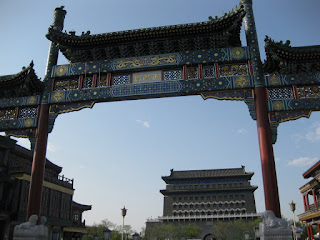

Located south of the Tiananmen Square, Qianmen main street has been converted into a horrendously fake tourist wonderland, looking more like Disneyland Main Street than an authentic ancient Beijing street. That's modernity in Beijing, where heritage usually gives way to headless commercialism. I don't have a problem with them remaking a place to keep it modern, relevant and hygienic. But this effort is a joke. Check out the dumb ass big bird cages which lined the street.


So enjoy the joke of a scene while you queue up at Duyichu (10-6702-1555), which does not take reservations. Too bad, you are not an emperor.

Tuesday, December 30, 2008

Dim sum brothel


Almost everything was wrong with the Golden Tripod Attic. The decor was off, the music was wrong and even the name was just, well, weird. Seriously, what kind of name is "Golden Tripod Attic"? Given that the Chinese name is 金鼎轩, I will venture that a better translation should be "House of Golden Peak"? Sounds better already doesn't it?


The architecture of the restaurant was like a faux imperial-style mansion and it ended up just looking like a faux imperial-style brothel. The bloody red lanterns didn't help. The restaurant blasted techno music outside its doors, perhaps in the hope that its loud, repetitive beats would warm up the crowd. My goodness, this place was a joke.

Until you try its dim sum that is. The only thing funny after that was how good and how cheap it was. I actually stumbled into the Attic by accident. Being the smart ass that I am, I decided to check out a job fair on a Monday morning at 8.30, thinking that I may be able to catch a sight of shivering job seekers waiting in line to fill in their resumes. I was wrong. The only shivering dude was me. Young Beijingers may be having a hard time finding employment, but they are not so dumb as to hunt for one at -6C.

Disappointed and cold, I dashed into the hideous-looking Attic, which was just next to the job fair. The waiters wore ridiculous Santa hats. But at least they were employed. I asked for Chinese tea, didn't even bother to take off my jacket, and grabbed the menu. Ordered chee cheong fun (rice flour roll), lo mai kai (glutinous rice with chicken), carrot cake and Sichuan noodles.


What was served just warmed my frozen belly. The chee cheong fun had smooth, silky skin with a delightful sauce over it. But it was the fried carrot cake that made me a tripod too. Now, I may not be an expert of anthropology or other ant-like studies, but I do know my carrot cake. In Singapore, it is called "chye tow kway" and if it is a subject in the university, I ought to be a lecturer. My professorship was earned by my close examination of all famous carrot cake stalls in Singapore. I love them black, white or brown, which was how the Attic does it. Crispy on the edges and fluffy and soft inside. It may be more oily than Crystal Jade's, but it sure beats it pants down. I usually take my carrot cake with some chilli, but this one was so good that it had to be eaten au natural.

It costs just 8.80 yuan for a plate, and a sumptuous dim sum meal would not set you back by more than 40 yuan or about S$8. It gets even cheaper if you go during its extraordinarily-long Happy Hours (2 to 5pm; 10pm to 11am). Oh yes, it is opened 24 hours. So you can get awesome dim sum round the clock!


The restaurant has five branches. I was at the Temple of Earth - where the emperors used to make offerings to the deities of earth - outlet (10-6429-6888), but there is also one at the swanky Shin Kong Place. Don't bother going to the Temple itself. It is a poor cousin of the Temple of Heaven - one of Beijing's most breathtaking ancient architecture. Just go to the adjacent whorehouse-looking Golden Tripod Attic. And be the slut to its dim sum mastery. I am, and I'm damn proud of it.